

 Accountability.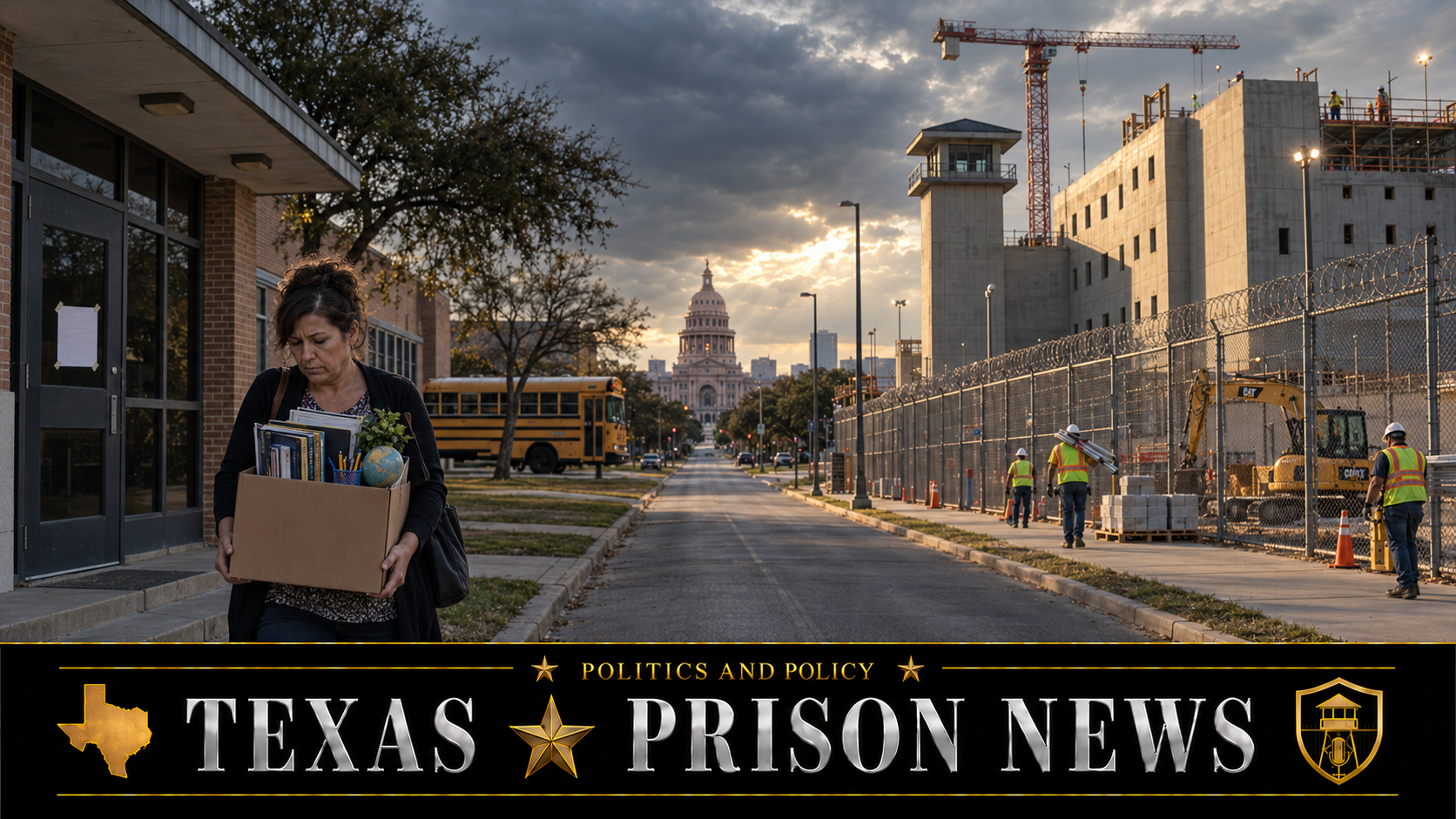

Republicans have controlled the Governor’s Office, Texas Senate and Texas House for more than two decades. The state’s current priorities are not accidental—they are the product of sustained one-party government.
For more than two decades, one political party has controlled every institution responsible for writing and approving the Texas state budget.
Republicans have simultaneously held the Governor’s Office, the Texas Senate and the Texas House since 2003. Every recent increase in prison funding, every decision that kept the basic student allotment nearly frozen and every state budget that prioritized correctional expansion over flexible classroom funding was enacted under unified Republican control.
Local school boards formally decide whether individual campuses will close and which positions will be eliminated. Declining enrollment, expiring federal assistance and local financial decisions can also contribute to those outcomes. But school districts operate within a funding system designed and financed by the state.
When districts cannot keep pace with inflation because Texas maintained the basic allotment at $6,160 per student for six years—and then increased it by only $55—responsibility does not end at the local school-board table. It extends to the Republican governor and Republican legislative majorities that determined how much flexible funding schools would receive.
During the same period, Texas demonstrated that it could act aggressively when the prison system requested additional resources.
The state approved correctional-officer raises, prison repairs, infrastructure projects, new equipment and the reopening of prison capacity. These were not decisions forced upon Republican leaders by Democrats. Democrats did not control the budget-writing process, either chamber of the Legislature or the governor’s veto pen.
These were Republican budgets reflecting Republican priorities.
TDCJ Received the Money It Requested
For years, the Texas Department of Criminal Justice warned lawmakers that it needed more money, more correctional officers, higher salaries, substantial facility repairs and enough employees to reopen prison capacity that had become unusable because of staffing shortages.
The Republican-controlled Legislature responded.
TDCJ’s annual operating budget increased from approximately $3.5 billion in fiscal year 2022 to more than $4.2 billion in fiscal year 2025. For the 2026–27 biennium, the agency received approximately $9.4 billion in General Revenue-related funding.
The increases included significant correctional-officer pay raises, recruitment and retention measures, facility repairs, infrastructure improvements, body cameras and rising prison healthcare expenses.
Correctional officers perform difficult and frequently dangerous work. Texas cannot safely operate its prisons without enough trained employees, and officers deserve competitive salaries and safe working conditions.
But budgets reveal priorities.
Texas has proven that it can find substantial new money when state leaders decide an institution must be strengthened. The question is why the state has not responded with the same urgency when public schools warn that they are approaching financial crisis.
More Education Money on Paper—But Insufficient Classroom Relief
Texas officials frequently point to the total amount appropriated for public education as evidence that the state is spending more than ever.
In nominal dollars, that is true.
But nominal totals do not tell parents what their neighborhood schools can afford. Education funding must be evaluated against inflation, enrollment, transportation expenses, employee benefits, utilities, special-education requirements and other rapidly increasing costs.
A dollar appropriated today does not purchase what that same dollar purchased in 2019.
The basic allotment—the central building block of the Texas school-finance system—remained at $6,160 per student from 2019 through 2025. House Bill 2 finally increased it, but only by $55, bringing it to $6,215 per student.
That represents an increase of less than 1% after six years of inflation.
Texas approved an $8.5 billion public-education package in 2025. It included targeted teacher raises, special-education assistance, safety funding and other valuable programs. Those investments are real and should be acknowledged.
However, much of that money was restricted to designated purposes. Only a fraction gave districts the flexible operational funding they need to pay utility bills, maintain transportation, retain librarians and counselors, employ support personnel and cover other routine expenses.
Property-tax relief also increases the amount associated with public education in the state budget, but money used to lower property taxes does not necessarily place additional resources inside classrooms.
A multibillion-dollar education package can therefore coexist with local school closures, job eliminations and program reductions.
That is precisely what Texas is experiencing.
Schools Are Closing and Positions Are Disappearing
The consequences are no longer theoretical.
Austin Independent School District approved the closure of 10 schools. Approximately 3,796 students were affected, and more than 6,300 seats were eliminated through the consolidation process.
Judson Independent School District approved the permanent closure of four campuses and the elimination of 536 positions for the 2026–27 school year. District administrators expected attrition and existing vacancies to prevent many of those reductions from becoming direct layoffs, but occupied positions also remained at risk.
El Paso ISD faced a budget shortfall approaching $53 million. Crystal City ISD reportedly reached a point at which it had less than $500 available in its bank account.
Across Texas, school boards have been forced to consider campus closures, hiring freezes, unfilled positions, larger classes and reductions affecting teachers, librarians, counselors, aides and other support employees.
Republican state officials did not personally order every one of those closures. Local boards made the final decisions, and districts face different combinations of declining enrollment, expiring federal pandemic assistance and local financial problems.
Nevertheless, state policy created the financial environment in which those boards were forced to operate.
Republican leaders cannot keep the basic allotment nearly unchanged for six years and then treat the resulting local budget emergencies as somebody else’s problem.
Texas Has Shown That It Can Act Decisively
The contrast with the prison budget is difficult to ignore.
When TDCJ warned of dangerous staffing shortages, Texas approved major correctional-officer pay increases.
When prisons needed repairs, lawmakers appropriated infrastructure funding.
When closed or understaffed prison capacity became a political priority, the state found the resources to address it.
When school districts warned that inflation had eroded classroom funding, however, the state left the core allotment unchanged for six years and ultimately increased it by only $55.
This is not an argument for underpaying correctional officers or operating unsafe prisons. It is an argument for applying comparable urgency to the institutions capable of preventing future incarceration.
Texas spends more than $25,000 annually to confine one state prisoner. Direct comparisons with education require caution because school funding includes combinations of state, local and federal money. Nevertheless, the underlying imbalance remains unmistakable: Texas will accept the substantial cost of incarcerating an adult while resisting smaller preventive investments that could help a child succeed before ever entering the criminal-justice system.
A safe prison system is necessary.
A prison-centered public policy is not.
Education and Rehabilitation Are Public-Safety Investments
Texas cannot incarcerate its way out of every social problem.
Strong public schools, qualified teachers, special-education programs, mental-health treatment, substance-use services and stable families are all public-safety investments. They address risk factors before those risks become arrests, prosecutions and prison sentences.
The same principle applies inside prison.
Academic education, vocational training, addiction treatment, cognitive-intervention programs and meaningful release preparation can reduce prison misconduct and improve a person’s likelihood of succeeding after incarceration.
Parole decisions should carefully distinguish between prisoners who continue to present a serious danger and those who have demonstrated sustained rehabilitation.
If Texas spends billions of dollars expanding prison operations but fails to invest adequately in rehabilitation and responsible release planning, it is funding confinement without creating safer long-term outcomes.
Correctional officers deserve fair pay. Teachers deserve fair pay. Parole officers need manageable caseloads. Students need functioning schools. Prisoners who have genuinely changed need meaningful opportunities to demonstrate that change.
Those priorities do not have to compete. Texas is wealthy enough to support all of them.
But state leaders have repeatedly treated some needs with far greater urgency than others.
Responsibility Is Not Evenly Divided
Republicans have exercised unified control over Texas state government for more than two decades.
Democratic lawmakers could propose amendments, vote against legislation and advocate for different priorities. But they did not possess the votes to write the final budgets, control legislative committees or force the governor to sign a different spending plan.
Responsibility for the present system is therefore not evenly divided between the two parties.
The long-term balance Texas has created between prisons and public education must be evaluated as the record of Republican governance.
That record includes the 2025 education package, which directed billions toward teacher compensation, special education, school safety and other needs. It also includes a $1 billion private-school voucher program championed and signed by Governor Greg Abbott.
Most importantly, it includes the continuing financial distress reported by public school districts even after lawmakers approved the education package.
The package helped, but it did not resolve the underlying problem. Campuses continued closing, positions continued disappearing and school officials continued warning that flexible per-student funding had failed to keep pace with actual expenses.
The 2026 Election Presents a Choice
The 2026 election gives Texans an opportunity to decide whether the state should continue along its present course.
Republican Governor Greg Abbott is running on his record and a continuation of the policies his administration has pursued. His party controls the state government responsible for the prison appropriations, education budgets and private-school voucher program discussed in this article.
Democratic gubernatorial nominee Gina Hinojosa has made saving public schools a central part of her campaign. Her published education proposals include placing an experienced educator in charge of the Texas Education Agency, changing the state’s high-stakes testing and accountability system, and increasing the emphasis placed on neighborhood public schools.
Hinojosa’s education agenda presents a clear alternative to the state’s current direction.
That does not mean voters should give any candidate a blank check.
Supporting public education does not automatically establish a complete criminal-justice platform. Hinojosa and every other candidate seeking statewide office should be required to explain their positions on rehabilitation, prison education, parole transparency, independent oversight, substance-use treatment, manageable parole-officer caseloads and alternatives to incarceration where public safety permits.
Texas voters should demand specific commitments—not merely campaign slogans.
The governor appoints members of the Texas Board of Criminal Justice and the Texas Board of Pardons and Paroles. Those appointments can influence prison oversight, parole policy and the culture of the agencies responsible for deciding who remains incarcerated and who is released.
The governor also has substantial influence over which issues receive priority during legislative sessions and whether bills become law.
The election therefore matters to public education, prison policy and parole reform.
What Does Texas Want to Build?
Texas can afford secure prisons and properly funded schools. The state does not have to choose between safe correctional institutions and successful classrooms.
The real choice is whether Texas will continue treating incarceration as an urgent investment while treating education and rehabilitation as expenses that can wait.
A state that closes neighborhood schools while reopening prison capacity sends a troubling message about what it expects from its future.
A state that allows education jobs to disappear while aggressively increasing corrections spending is deciding where opportunity ends and punishment begins.
For more than two decades, Republicans have controlled the institutions responsible for making those decisions. They cannot campaign as outsiders to a system they created, funded and managed.
Texas must invest before children enter the criminal-justice system. It must provide meaningful rehabilitation to people already incarcerated. It must make parole decisions based on public safety, genuine risk and demonstrated change.
Prisons may be necessary, but they should never become the institution Texas is most willing to build.
This article is an editorial and policy analysis by Texas Prison News. It advocates for greater investment in public education, evidence-based rehabilitation and meaningful parole reform.